
Compact & Highly Efficient
Our m-MBBR® System Removes BOD, Ammonia & Suspended Solids with Exceptional Consistency
High-Quality Wastewater Treatment
The m-MBBR® uses biofilm carriers and integrated aeration to handle load variations and toxic shocks at market-leading flow rates.
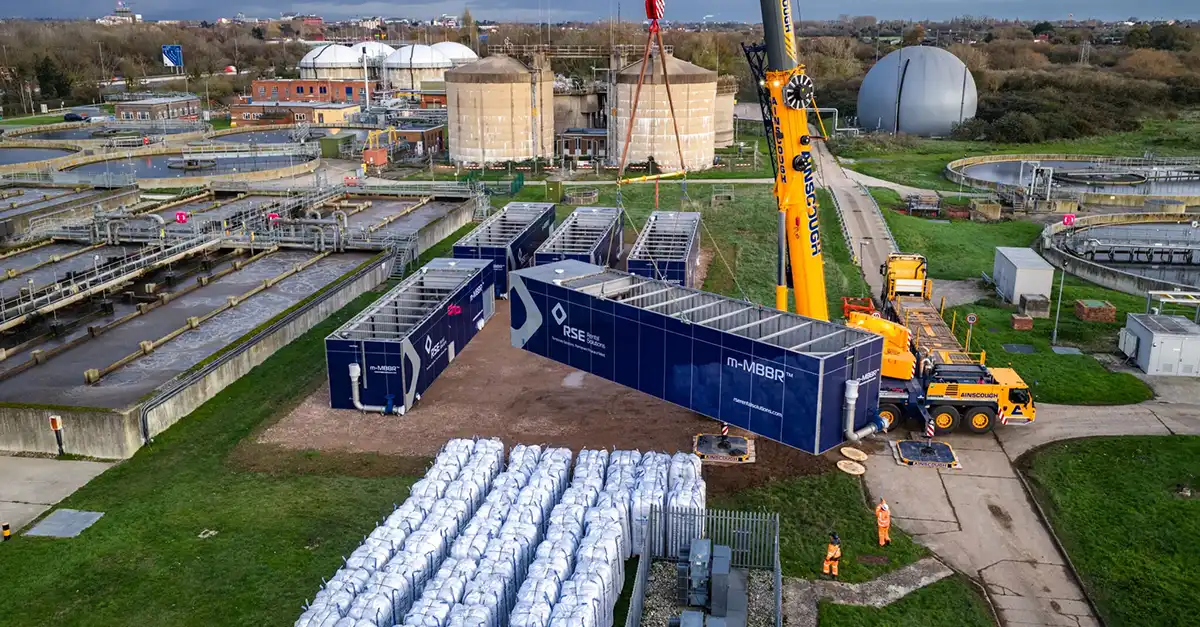
It’s made from compact, plug-and-play modules that are built and factory-tested at our state-of-the-art assembly facilities. This makes the m-MBBR® ideal for fast deployment at scale. It can be bought or rented.
Whether for drinking water, industrial or emergency applications, the m-MBBR® can be customised to suit site-specific needs. It’s suitable for preliminary, secondary, tertiary and side-stream applications.


Key Benefits of the m-MBBR®
- Can treat wastewater flows of over 150,000 m3/d, taking them down to as little as 25 m3/d
- Over 90% BOD and ammonia removal during early startup phases
- Superior treatment performance at a lower lifetime cost than conventional, site-built alternatives
- Up to 67% lower embodied carbon than traditional site-built wastewater treatment plants, due to low-carbon manufacturing methods and carefully sourced materials
- Can be fully automated and operated remotely, if required
How the Technology Works
Our carrier biofilm technology has been continually improved over more than 30 years of global operating experience. The result is a system that helps companies comply with discharge consents and, compared with competing technologies, offers a small footprint and easy scalability to meet future treatment needs.
The submerged biofilm carriers provide a large surface area for microbial growth, and aeration ensures uniform mixing and optimised oxygen transfer, provided by duty/standby blowers.
m-MBBR® Configurations
BOD reduction – The standard m-MBBR® module is configured as a 3-stage biological reactor with an integrated 2-phase solids separation stage. Dividing the biological reactor into three separate but interconnected stages is more efficient.
BOD & total nitrogen reduction – The 1st-stage reactor is configured as an anoxic zone, where denitrification of the nitrified liquors from the 3rd-stage reactor occurs. The 2nd-stage reactor is dedicated to BOD removal, with additional BOD and ammonia reduction achieved in the 3rd-stage reactor before the 2-phase solids removal stage. This configuration also provides beneficial levels of alkalinity in the treated water discharge.
BOD & ammonium (NH4) reduction – The 1st and 2nd stages are used for BOD reduction. The 3rd and final stage is used for nitrification of the treated wastewater before the 2-phase solids removal stage.
Tertiary nitrification – For existing works that are failing to meet ammonia discharge consents, the m-MBBR® can be configured to provide a very cost-effective nitrification stage. This works as a stand-alone facility or can be integrated within the existing works as a side-stream reactor.
Three m-MBBR® Models to Choose From
Designed and manufactured at our state-of-the-art fabrication facilities near Inverness
Evo
- Can be configured for BOD reduction, BOD reduction and nitrification, or BOD and total nitrogen reduction (nitrification and denitrification).
- Produces solids and a high-quality effluent with a low total suspended solids concentration.
- Fully automated biological treatment with 2-phase integral solids separation.
- Available in 3 standard sizes, with 4 configurations for each module size.
- All standard systems use conventional road transportation and can be quickly made fully operational, making them suitable for permanent or temporary use.
Bio
- Ideal when solids separation is not required but BOD removal with nitrification, or combined BOD and total nitrogen reduction, is needed.
- Fully automated biological treatment with integrated blowers and controls.
- Incorporates a 3-stage biological treatment, similar to the Evo model, but offers higher treatment capacity due to the absence of a solids separation stage.
Airo
- A single-stage biological process, particularly suitable for higher flow applications to significantly reduce load or for tertiary nitrification.
- Suitable for higher flow and load applications than the Evo and Bio models, and operates without solids separation.
- Can be used for either BOD or ammonia (nitrification) reduction.
- Reactors can be combined in a series to provide full treatment, with solids separation in an independent process.
Available sizes across all models:
14 x 2.5 x 3.0 m
15 x 3.6 x 3.0 m
18 x 4.0 x 3.5 m
FAQs
Does the m-MBBR® require primary settlement?
The m-MBBR® requires 6 mm screening and grit removal, but primary settlement is not always necessary. The system can be configured for applications with or without primary settlement, depending on the incoming wastewater characteristics and treatment requirements.
How is the biomedia kept securely within the m-MBBR®?
RSE’s patented internal retention screens keep the biomedia securely within the m-MBBR® module. The system also incorporates sufficient hydraulic headroom to minimise the risk of overtopping during normal operation and potential foaming during commissioning.
How quickly can an m-MBBR® become fully operational?
An RSE m-MBBR® can typically be ready for delivery within 10–14 weeks of receiving an order. Each module arrives fully assembled and factory tested, with minimal mechanical and electrical connections for rapid installation. Once seeded with activated sludge, BOD treatment is typically established within two weeks and nitrification within three to four weeks, depending on site conditions and loading.
What can the m-MBBR® treat, and what effluent standards can it achieve?
The m-MBBR® range supports BOD removal, nitrification and denitrification for total nitrogen reduction, including the treatment of sludge and return liquors. Models are available for biological treatment alone or complete treatment incorporating solids removal. Following an application review, the system can be designed to achieve treated effluent concentrations below 20 mg/L BOD, 5 mg/L ammoniacal nitrogen, 10 mg/L total nitrogen and 25 mg/L suspended solids, subject to the site-specific influent characteristics and consent requirements.
How is the m-MBBR® controlled?
Each RSE m-MBBR® includes a purpose-built motor control centre with PLC-based controls and operating software, housed within the module’s integrated control room. This provides operators with a straightforward interface for monitoring and controlling the treatment process.
Can an m-MBBR® be installed without interrupting existing treatment operations?
In many applications, the m-MBBR® can be installed and commissioned offline as a side-stream capacity upgrade or replacement for an existing treatment process. Once the biomass has acclimatised and the required performance has been confirmed, the module can be integrated into the works with minimal disruption to ongoing treatment.
What routine maintenance does an m-MBBR® require?
The m-MBBR® is designed for largely unattended day-to-day operation and is expected to require fewer than 100 operational and maintenance hours per year. Routine activities primarily include instrument calibration, equipment inspections and visual checks of mechanical operation.
How does deploying an m-MBBR® reduce construction-related carbon emissions?
The standardised, factory-built m-MBBR® approach reduces construction-related carbon by limiting site activity, concrete use, heavy machinery, waste and transport requirements. In RSE’s comparison, project emissions reduced from 303 tCO₂e for traditional on-site construction to 161 tCO₂e for off-site modular construction—an indicative reduction of approximately 47%.
Why choose an RSE m-MBBR® instead of a traditional concrete treatment plant?
RSE m-MBBR® provides a faster, lower-impact alternative to a traditional concrete treatment plant. The compact modules are manufactured, assembled, tested and pre-commissioned off-site, then delivered ready for installation on a suitable flat hardstanding. This significantly reduces civil works, site programme, preliminaries, labour, plant and other wrap-around costs while also reducing concrete use, construction waste and carbon emissions.
Enquire Now
Speak to Our Team
Learn more about our business, products or services by completing the form, or alternatively fill in our public feedback form here.