A Flexible Solution for Standalone or Integrated Treatment
Ion exchange systems are a compact and flexible solution that can be deployed as a standalone process or as part of a wider treatment train. Cost-effective and resilient, they maintain consistent performance across many treatment cycles.
Targeted Treatment Using Specialist Resin Media
This water treatment technology uses specialised resin media to selectively remove dissolved ions from water by exchanging them for less harmful ones. It’s highly effective for treating nitrates, ammonia, hardness, heavy metals, PFAS and other dissolved inorganic compounds.

ION Exchange
This water treatment technology uses specialised resin media to selectively remove dissolved ions from water by exchanging them for less harmful ones. It’s highly effective for treating nitrates, ammonia, hardness, heavy metals, PFAS and other dissolved inorganic compounds.
Ion exchange systems are a compact and flexible solution that can be deployed as a standalone process or as part of a wider treatment train. Cost-effective and resilient, they maintain consistent performance across many treatment cycles.

Our Ion Exchange Products
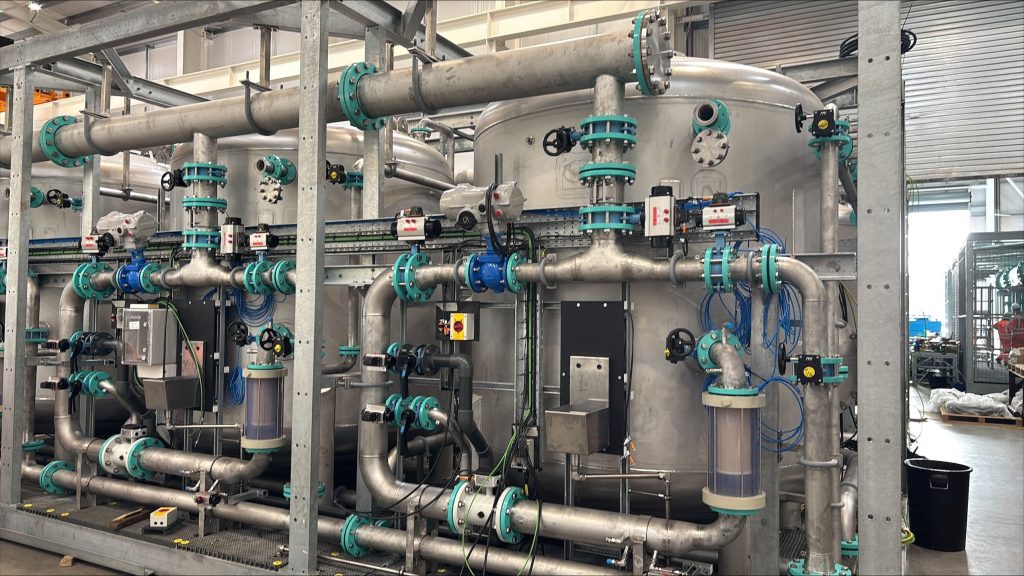
m-Ion®
m-Ion®
FAQs
What Contaminants Can Ion Exchange Remove?
Ion exchange removes charged species by swapping them for harmless ions held on a resin. In drinking water, it targets nitrate, sulphate, hardness, colour, dissolved organic carbon, ammonium, fluoride, uranium and PFAS. Resin selection is what decides which contaminant a given plant removes.
Can Ion Exchange Remove Nitrates?
Yes, and it is the process most widely used for nitrate in the UK. Nitrate-selective resin removes nitrate without releasing it preferentially as the bed loads up, avoiding nitrate dumping that ordinary anion resins can cause. Treated water is usually blended to a target safely below the 50 mg/L limit.
How Does Resin Regeneration Work?
As the resin approaches exhaustion, the plant takes the vessel offline and passes a concentrated regenerant, usually brine, through the bed. The contaminant ions come off, the resin returns to its original form, and a rinse brings the vessel back into service. The whole sequence is automatic and usually takes under an hour.
How Quickly Can a Modular Ion Exchange Plant Be Delivered?
A standard modular plant can be delivered in 6 to 12 months, and repeat units faster still. RSE builds and tests the plant in our state-of-the-art production facility while the site works proceed, so installation and commissioning on site take weeks rather than months.
Is Ion Exchange Suitable for Remote Sites?
Yes. It runs at low pressure, needs only salt deliveries and is fully automated, so it suits sites with limited attendance. Remote monitoring lets your operators check performance, regeneration cycles and salt stock without travelling to site.
Can Ion Exchange Be Combined With Membrane Treatment or GAC?
Yes, and combinations are common. Ultrafiltration or ceramic membranes ahead of ion exchange protect the resin from solids. GAC downstream handles pesticides, taste and odour. For PFAS, ion exchange and GAC in series often give the best whole-life result.
Enquire Now
Speak to Our Team
Learn more about our business, products or services by completing the form, or alternatively fill in our public feedback form here.